Join the community building the next industrial revolution.
Help us shape a new kind of convening.
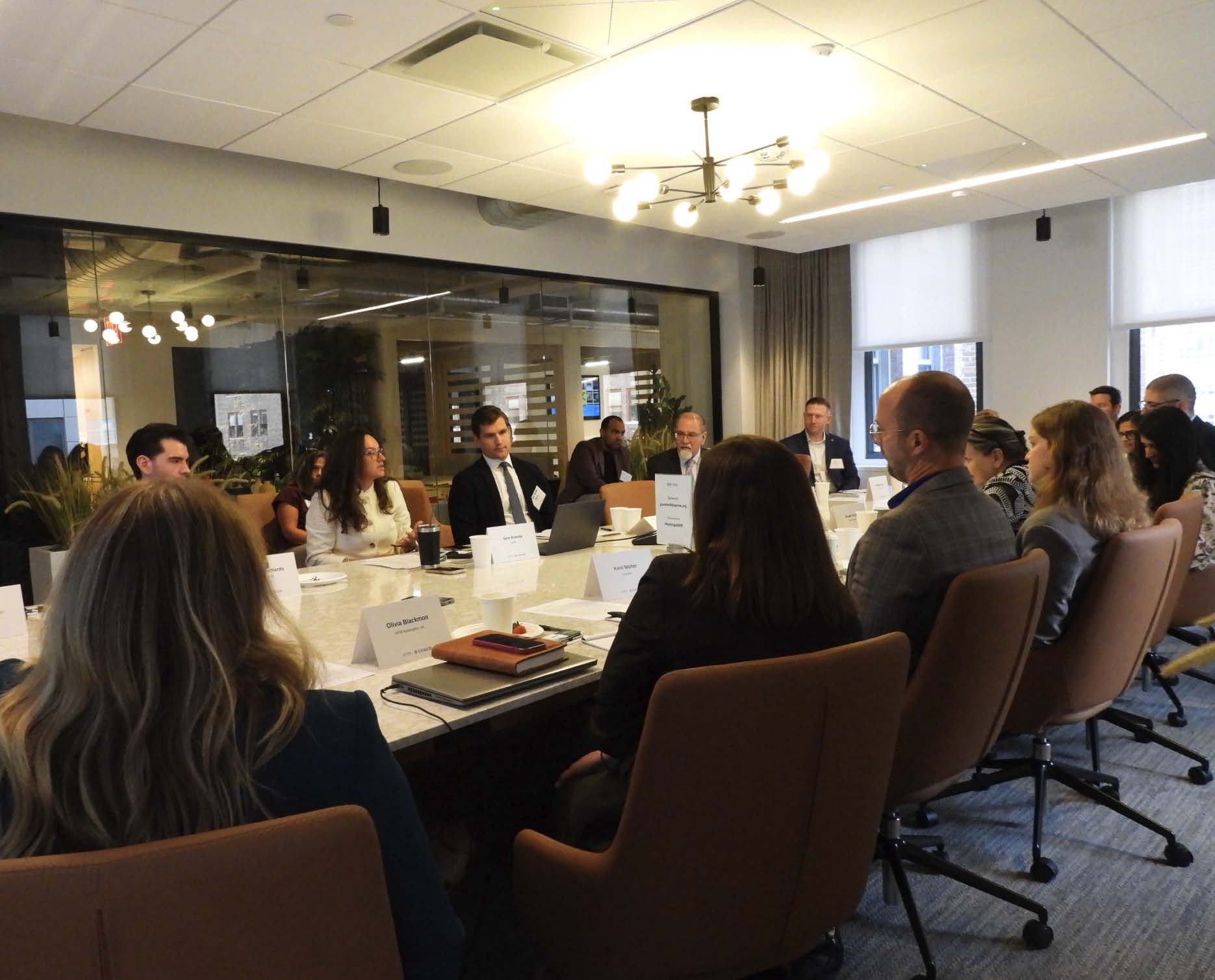
Who Was in the Room
Nuclear Developers and Operators • Building Trade Unions • Federal Government • Think Tanks • Workforce and Industry Organizations • Policy • Engineering Consulting Services • Philanthropy • Hosts from ASME and Constructive
*This roundtable was held under Chatham House Rule. Nothing that follows in this takeaways document is attributed. Statistics and figures quoted here came from speakers’ own analyses and their accuracy cannot be guaranteed. However, we have provided a list of further references and resources at the end of the document. This summary was developed with the assistance of AI transcription and synthesis tools.
NYC Climate Week Nuclear Workforce Roundtable
Join the community building the next industrial revolution.
Help us shape a new kind of convening.
ASME convened leaders from across the nuclear ecosystem at Climate Week NYC to discuss how to build the nuclear workforce at the speed demanded by today’s context of the AI buildout, electrification, reindustrialization, and a federal goal to quadruple US nuclear capacity by 2050.
Over 90 minutes, the facilitated discussion led by Constructive covered three topics: 1) the current nuclear workforce landscape, 2) how to build talent to meet projected growth, and 3) which near-term actions could accelerate progress. Insights from the discussion will help shape the program for CATALYZE, ASME’s new summit in Detroit in April 2027.
By the Numbers
19
people at the table
18
Organizations Represented
375,000
more nuclear workers needed to reach just 200GW capacity by 2050
(DOE Liftoff, 2024)
400GW
total US nuclear capacity targeted by 2050 (DOE Fact Sheet, 2026)
2 in 5
of today’s construction workforce projected to retire by 2031
(NCCER, 2025)
1 in 5
STEM roles in nuclear held by women across NEA countries (NEA, 2023)
Five Key Takeaways
Takeaway 1: The workforce shows up for signed projects,
not press releases.Unions and training programs can scale up, but the long lead times for nuclear projects create a fundamental timing problem: workforce investment follows committed projects, not announcements. Until then, the nuclear-trained workers move to data centers and other sectors offering immediate employment. Retaining that talent requires a more continuous pipeline of work: sequencing outages, plants built in fleets rather than one at a time, and potentially aggregating reactor orders across multiple buyers.
not press releases.
Unions and training programs can scale up, but the long lead times for nuclear projects create a fundamental timing problem: workforce investment follows committed projects, not announcements. Until then, the nuclear-trained workers move to data centers and other sectors offering immediate employment. Retaining that talent requires a more continuous pipeline of work: sequencing outages, plants built in fleets rather than one at a time, and potentially aggregating reactor orders across multiple buyers.
The workforce shows up for signed projects, not press releases.
The capacity to train is there. The unionized building trades run more than 1,900 training facilities on over $3 billion a year of private money, raised by workers setting aside cents from each hour’s pay.1 More than 300,000 people enrolled in their registered apprenticeships across 2024 and 2025.2 Growing that further depends on signed agreements and the right market signals — “less so press releases, and more so actual conversation and demonstration that it’s real.”
Public money is limited, and some of it remains capped. Federal university nuclear leadership programs are authorized at about $15 million a year each at Nuclear Regulatory Commission (NRC) and National Nuclear Security Administration (NNSA) — “not a lot per agency” — any significant expansion likely requiring congressional action.3 And the funds that are available are difficult to access – one participant noted that allocated federal apprenticeship money is “sitting there waiting to be spent” while a contract award is contested.
The workforce pipeline is leaking during long project lead times. Time in the field is essential to shortening the path to proficiency and that experience can only be built when real work is available. When projects don’t materialize, early-career staff “jump to another sector of the energy world or just a different sector altogether… wherever the work is.” Data centers emerged as a clear competitor for talent, with several participants indicating they are already losing workers to the sector. Advanced manufacturing is also drawing from the same talent pool. According to the local electricians’ union, a semiconductor fab under construction near Syracuse, New York, could need 1,600–1,700 electricians at peak, which is more than the 1,500 electricians currently in the entire central New York region.4
Sequencing is a workforce tool. Outage schedules are being reworked so that craft workers can go from one site to another. A single new plant can need around 1,600 workers on site at the peak of construction.5 The ability to move experienced crews from one unit directly to the next strengthens the workforce case for building in fleets. One participant extended the same logic to procurement:
“Everybody waits to be number five or six. So why don’t we just all do six together?”
Takeaway 2: Headcount is the wrong unit.The forecasts count people, but participants asked: which roles are actually needed? How many workers move from one site to the next? How is productivity impacted by well-trained crews? How does AI change the nature of the work itself? Participants called for a shared roadmap, co-created with academia, labor, and schools, to help answer these questions and chart a pathway forward.
The forecasts count people, but participants asked: which roles are actually needed? How many workers move from one site to the next? How is productivity impacted by well-trained crews? How does AI change the nature of the work itself? Participants called for a shared roadmap, co-created with academia, labor, and schools, to help answer these questions and chart a pathway forward.
Headcount is the wrong unit.
The numbers are big. DOE’s Liftoff analysis estimates the US nuclear workforce would need to grow by about 375,000, from roughly 100,000 today, to triple capacity to around 300 GW by 2050.6 The Trump administration’s goal of 400 GW by 2050 goes even further.7 Fusion is growing from a smaller base: 56 companies now directly employ about 5,600 people, and cumulative investment has multiplied more than 7X since 2021.8,9
Four arguments suggested the forecasts may not capture the full picture and underscore the scale of the challenge:
- Technology mix.
Staffing varies enormously between technologies in the industry, so a single headcount hides a wide range. As one participant put it, “staffing is very, very different from a microreactor all the way up to a light water reactor.” - Mobility.
Most demand estimates don’t discount for workers flowing from one job site to the next—the laborers and operating engineers who prepare a site and then move to the next project. Core trade skills are also transferable. An electrician can work “on a solar farm one day, an offshore wind farm the next, and then a nuclear power plant the third.” About 35,000 people worked on the Vogtle expansion over the life of the project.10 - Productivity.
A 2022 study of 1,550 US projects, commissioned by a union-contractor fund, found union craft labor 14% more productive, total project costs 4% lower, and projects 40% less likely to hit a shortage of skilled labor.11 For investors, that last figure is the business case, in an industry where “if things go wrong, they go really wrong.” - AI.
AI is not making welds or turning wrenches, but it is already a force multiplier for jobsite safety and productivity, and for building training curriculum faster. Not every part of the system expects to grow in proportion to the build: at least one organization at the table shared plans to hold staffing roughly flat and absorb growth through efficiency.
What’s missing is a forecast of the jobs, not the headcount. The room called for a collective roadmap for how to leverage AI in nuclear education, training, and workforce—co-created with academia, labor unions, apprenticeship programs, and high schools—and predictive models of how AI changes job types, not just the numbers.
“You’re going to need 1,000 workers. But how is artificial intelligence transforming those thousand workers?”
Takeaway 3: The retention problem is a job design problem.Women and younger workers are increasingly looking for greater flexibility and many leave for similar reasons: shift schedules, childcare constraints, and workplace culture. While hiring women into the sector is improving, retention remains the harder challenge. Several of the underlying issues are within employers’ control, though participants differed on how much of the workplace culture, 24/7 operations, and expectations of specific roles can be altered.
Women and younger workers are increasingly looking for greater flexibility and many leave for similar reasons: shift schedules, childcare constraints, and workplace culture. While hiring women into the sector is improving, retention remains the harder challenge. Several of the underlying issues are within employers’ control, though participants differed on how much of the workplace culture, 24/7 operations, and expectations of specific roles can be altered.
We need more attractive jobs.
Hiring women is improving; retaining them is the bigger challenge. Women make up about a quarter of the nuclear workforce across NEA countries, and 21% of its STEM workforce.12,13 Hiring of women has trended up over recent survey cycles, with a small reversal in the latest, but “our bigger issue with women is not just hiring, but retaining them.” Industry focus-group findings cited in the room suggest half of younger workers leave within their first 3-5 years.
The reasons are similar for both groups:
- Shift work.
Plants run longer shifts (4/10’s or 5/10’s, and 7/12’s during outages), while other employers offer hybrid and remote work. Early-career engineers are turning down the licensed-operator track to keep two days a week at home: “I want to have a life.” That keeps them in engineering, but it creates a bottleneck in the pathway to licensed operators. Not everyone thinks the pattern can change: “I don’t know how we would ever get away from that, because people need to be at the plant to operate it.” - Childcare.
Many plants are in rural or remote sites, where access to childcare can be limited and cost prohibitive. On construction sites, a 5:30 a.m. shift can mean a 4 a.m. drop-off. The building trades have piloted providing childcare support in Milwaukee and New York City.14 - Culture.
Plants remain male-dominated, with a military culture carried in by veteran employees. “Sometimes it still feels like it’s the 1970s inside these plants.”
The room split on how much of this can be fixed. “Those are fixable problems.” “Culture’s going to be hard to fix.”
The trades show what deliberate effort looks like. Apprenticeship-readiness programs sponsored by building trades councils grew from more than 220 in early 2024 to almost 300 by August 2025, including programs inside California’s prison system.15,16 Nearly 6,000 union tradeswomen are expected at the Tradeswomen Build Nations conference in Houston in October.17
“Broadening the pipeline isn’t about finding new populations to recruit from. It’s about not losing the ones we already have.”
Takeaway 4: “Death by PowerPoint” is a barrier to recruitment.New entrants accustomed to interactive technology and AI are often met instead with stacks of manuals and nearly 18 months of memorization. Modernizing training could improve recruitment, retention, and time to proficiency at the same time, particularly as a new career cluster creates one of the strongest openings in years to reach students earlier.
New entrants accustomed to interactive technology and AI are often met instead with stacks of manuals and nearly 18 months of memorization. Modernizing training could improve recruitment, retention, and time to proficiency at the same time, particularly as a new career cluster creates one of the strongest openings in years to reach students earlier.
“Death by PowerPoint” is a barrier to recruitment.
The way the nuclear industry trains people has not kept pace with how new entrants learn. Students arrive accustomed to Chromebooks, interactive tools, and AI, then encounter training built around dense manuals and long periods of memorization. One participant described how a new trainee will be handed a big stack of notes, and told to, “go memorize, and in 18 months you’ll be prepared”. This model is increasingly out of step with what attracts and retains new talent.
The traditional pipeline is leaky. Graduates of the Navy nuclear program, a traditional source of recruits, are increasingly being drawn to data centers instead. That competition is compounded by a perception problem: as one participant put it, “we’re fundamentally not a very cool sector to be a part of.” Recruitment efforts range from state fairs to a careers site featuring science creators.
Fixes are under way, but they remain fragmented:
- Industry research and training bodies are moving from teacher-centered to learnercentered training.
- The building trades are using AI to help more than 20,000 instructors build more interesting curricula and train apprentices faster.18
- ASME and Penn State, with a $2 million DOE grant, are building a nuclear safety and quality-assurance certification pathway designed to cut time to proficiency—and want industry input on how AI should shape it.19
We need to start earlier. K-12 has been largely missing from the workforce conversation, even though a retiring generation makes middle and high schools the right target. Advance CTE’s modernized National Career Clusters Framework—the first major update since 2002—creates an Energy & Natural Resources cluster.20 A majority of states have now moved from adopting it to implementing it. Implementation needs industry partners to bring the curriculum to life.
“We need to modernize how we teach, or people are just going to see this as an ancient way of doing business.”
Takeaway 5: Accelerating growth in the workforce will not just be driven by new entrants, but also by unlocking existing talent.Codes, certification, and visa rules decide who counts as qualified. Broadening those pathways to non-nuclear suppliers, adjacent trades, and international talent is an important workforce lever that doesn’t require waiting for the next cohort of skilled nuclear workers to graduate.
Codes, certification, and visa rules decide who counts as qualified. Broadening those pathways to non-nuclear suppliers, adjacent trades, and international talent is an important workforce lever that doesn’t require waiting for the next cohort of skilled nuclear workers to graduate.
Recruit the workers who are already available.
Training is one lever. Qualification is another. The room kept returning to a question: how much of the gap is training, and how much is “opening up the supply chain and other pools of talent that currently exist”?
Adjacent workers are more readily transferable than they appear. Registered apprentices in the trades graduate with an associate degree, or credits toward one, through articulation agreements with community colleges. There are “a lot of steps” between a construction foreman and a licensed plant operator, but the path exists.
International talent is an opportunity with a price tag. US salaries go much further than pay in many developing countries, and skilled talent in these regions there are willing to relocate for higher compensation. The $100,000 fee on new H-1B petitions was cited as a barrier; one participant suggested DOE and NRC could make the case for adjusting it.
Asia cuts both ways. Eighteen months ago, nuclear was a hush-hush topic in the region; now “everybody is announcing.”21 The counterview: those same deployments are refining designs and construction practice, and broadening the aperture beyond US projects could bring the industry closer to nth-of-a-kind.
Codes inform who can do the work. The strength of the U.S. nuclear supply chain is determined by appropriately risk-informed application of standards. ASME’s role is to develop and maintain the technical standards based on consensus industry expertise. Adoption into the regulatory framework ultimately requires NRC action and that limits what companies can do. One proposal: allow more ASME Section VIII pressure-vessel components in safety-related nuclear applications, rather than Section III alone. Non-nuclear certificate holders far outnumber nuclear ones—by about 50:1, in one participant’s estimate—so the qualified supplier base, and the pool of talent behind it, could grow many times over. There is precedent: for non-LWR reactors, the NRC endorsed Section III, Division 5 for high-temperature reactors to allow reactor developers regulatory certainty, drawing on national-laboratory expertise on high temperature materials, and has since updated that endorsement.22
“The US is going to lose talent to Asia. Putting it bluntly.”
Pathways Forward
Up to $6,000 per apprentice. The Department of Labor’s Pay-for-Performance incentive covers nuclear energy infrastructure; sponsors can apply through intermediaries including Jobs for the Future from this autumn.23
A new career cluster in classrooms. States implementing the New Energy & Natural Resources Career Cluster need industry partners to bring the curriculum, and the opportunities that go with it, to life.24
Traineeships for the trades. The ADVANCE Act created a traineeship subprogram for the nuclear tradecraft workforce within federal university nuclear leadership funding.25
A certification pathway taking input. ASME invited industry guidance on the new safety and quality-assurance personnel certification pathway it is building with Penn State and Constellation Energy, including how AI should shape it.26
Programs worth copying. Childcare pilots, apprenticeship-readiness programs, community college articulation agreements, and the Aspen Institute’s work bringing community colleges together.
Who Else Should Be at the Table
- The builders. EPCs build the reactors and hire the crews through the unions.
- Federal and state government. The Departments of Labor and Commerce, state governments, regional and state consortia.
- Academia. Universities, community colleges and technical schools.
- Gen Z. Nuclear is Clean Energy (NiCE) student chapters and ANS student sections have many electrical and mechanical engineers who are passionate about nuclear.
- Underrepresented groups. Women in Nuclear, community-based organizations, and community college faculty and leadership.
- AI specialists. Organizations applying AI to nuclear operations and training, such as Nuclearn.
- Standards bodies. ANS alongside ASME, given its focus on workforce.
- International bodies. The IEA, the IAEA and the NEA’s Global Forum on Nuclear Education, Science, Technology and Policy, to which ASME is already connected.
- Hyperscalers. They bring financial resources and need the workforce “yesterday.”
Sources
- https://nabtu.org/press_releases/blackrockpartnershipaip/
- https://nabtu.org/press_releases/building-trades-union-membership-in-the-u-s-continues-to-grow-despite-industry-disruption/
- https://www.law.cornell.edu/uscode/text/42/16274a
- https://cnycentral.com/news/local/syracuse-area-workforce-pipeline-faces-growing-demand-for-skilled-electricians
- https://www.terrapower.com/downloads/grounbreaking-press-release.pdf
- Pathways to Commercial Liftoff: Advanced Nuclear
- https://www.whitehouse.gov/presidential-actions/2025/05/ordering-the-reform-of-the-nuclear-regulatory-commission/
- https://www.fusionindustryassociation.org/wp-content/uploads/2026/07/FIA-Industry-report-2026_d9.pdf
- https://www.fusionindustryassociation.org/wp-content/uploads/2026/07/FIA-Industry-report-2026_d9.pdf
- https://www.powermag.com/plant-vogtle-units-3-and-4-win-powers-plant-of-the-year-award/
- https://www.mcaa.org/wp-content/uploads/2023/01/IPA-Study-Quantifying-the-Value-of-Union-Labor-in-Construction-Projects- FINAL.pdf
- https://www.oecd.org/en/publications/gender-balance-in-the-nuclear-sector_f11a652d-en.html
- https://www.neimagazine.com/advanced-reactorsfusion/addressing-the-nuclear-gender-gap-11162379/
- https://tradesfutures.org/initiatives/child-care-pilot/
- https://tradesfutures.org/wp-content/uploads/2024/02/TF-ARP-Q-A-Feb.-2024-Final.pdf
- https://tradesfutures.org/wp-content/uploads/2025/08/TF-ARP-Q-A-August.-2025-Updated.pdf
- https://www.prnewswire.com/news-releases/nearly-6-000-union-tradeswomen-to-gather-in-houston-for-tradeswomen-buildnations- 302888188.html
- https://nabtu.org/wp-content/uploads/2025/04/Issue-Sheet-Apprenticeship-2025.pdf
- https://www.psu.edu/news/engineering/story/2m-doe-grant-fund-development-nuclear-industry-readiness-program
- https://careertech.org/news/modernized-national-career-clusters-framework-provides-a-forward-looking-industry-driven-model-toprepare- learners-for-sustainable-careers-through-cte/
- https://www.dw.com/en/nuclear-power-is-back-on-southeast-asias-energy-agenda/a-79358744
- https://www.nrc.gov/reactors/new-reactors/advanced/modernizing/guidance/asme-bpv-code-section3-div5
- https://www.dol.gov/newsroom/releases/eta/eta20260707
- https://careertech.org/news/modernized-national-career-clusters-framework-provides-a-forward-looking-industry-driven-model-toprepare- learners-for-sustainable-careers-through-cte/
- https://www.congress.gov/bill/118th-congress/senate-bill/870
- https://www.psu.edu/news/engineering/story/2m-doe-grant-fund-development-nuclear-industry-readiness-program
About the Road to CATALYZE
ASME CATALYZE is a two-day summit that assembles the community of engineers, investors, entrepreneurs, and enablers who are driving the next industrial revolution. The event is being held in Detroit in April 2027.
In the run up to CATALYZE, we are planning a series of satellite events collectively known as the Road to CATALYZE. These events are co-located at major existing convenings and target curated expert participants to discuss specific themes relevant to the CATALYZE 2027 program. As we develop these events, we are keen to collaborate with strategic partners to bring together relevant stakeholders for discussions on industry and energy topics with an aim to:
- Identify gaps and priority topics within themes for inclusion in CATALYZE 2027 program
- Share learnings from existing efforts on key topics and identify where further action is required
- Surface parallel efforts and initiatives where stakeholders can partner to make progress over the next year
(for action and further coordination at CATALYZE 2027)
About ASME
Advancing engineering for the benefit of humanity
The American Society of Mechanical Engineers® (ASME®) helps the global engineering community develop solutions to real world challenges. Founded in 1880, ASME is a not-for-profit professional organization that enables collaboration, knowledge sharing, and skill development across all engineering disciplines, while promoting the vital role of the engineer in society.
75,000+
members worldwide in 130+ countries
12,000+
individuals trained annually
6,400+
standards committees volunteers globally
6,900+
certified companies in 81 countries
330,000+
technical research papers in digital collection
560+
standards advancing industry
Appendix A: Resources mentioned
Reports and data
- DOE, Pathways to Commercial Liftoff: Advanced Nuclear (September 2024 update)
- OECD Nuclear Energy Agency, Gender Balance in the Nuclear Sector (2023)
- Fusion Industry Association, The Global Fusion Industry in 2026
- Independent Project Analysis, Quantifying the Value of Union Labor in Construction Projects (2022)
Programs and funding
- US Department of Labor, Pay-for-Performance Incentive Payments Program
- ADVANCE Act (2024), Section 402: Nuclear Energy Traineeship Subprogram
- Advance CTE, National Career Clusters Framework
- Trades Futures, apprenticeship readiness programs and childcare pilot
- Penn State, ASME and DOE, nuclear industry readiness certification
Codes and standards
- ASME Boiler and Pressure Vessel Code, Sections III and VIII
- US NRC, Regulatory Guide 1.87 (Section III, Division 5)
Networks and platforms
- NEA Global Forum on Nuclear Education, Science, Technology and Policy
- Nuclear is Clean Energy (NiCE) student chapters · ANS student sections · Women in Nuclear
- NuclearWorks (nuclear careers site) · Nuclearn (AI for nuclear training)
- Tradeswomen Build Nations, 9–11 October 2026, Houston
Appendix B: Participants

Andrew Richards
VP, Government Relations
TerraPower

Caroline Anderson
Director of External Affairs
Fusion Industry Association

Dan Randolph
Lead, Plant Training(Plant Field Technician);
XR Strategy Lead
X-energy

Dickson Lim
Lead, Philanthropy Advisory
Temasek Trust

Emily Bitgood
Manager, Workforce Development
Constellation

Gayatri Karnik
Policy Analyst
Anthropocene Institute

Hadia Sheerazi
Senior Fellow
Constructive

Iana Aranda
Managing Director, Sustainability
ASME

Kent Welter
Chief Engineer,
Testing and
Analysis
Nuscale

Lori Brady
Senior Director, Human Resources & Training Development
Nuscale
Mike Franovich
Director, Office of Nuclear Regulatory Research
NRC

Missy Henriksen
Executive Director
Center for Energy Workforce Development

Nicholas McMurray
Managing Director, International and Nuclear Policy
ClearPath

Olivia Blackmon
Vice President of New Nuclear
MPR Associates, Inc.

Richard Ollington
Managing Director
Emys Energy

Steve Chengelis
Vice President,
Energy
Supply, Nuclear
Development & Fusion
EPRI

Susan Kish
CEO
Constructive

Trevor Falk
Special Assistant to the President for Energy Policy
North America's Building Trades Unions
Also present:
Jarrett Reich, ASME | John Grimes, ASME | Joshua Swift, Constructive | Rosie Jewell, Constructive